Galleries One & Two
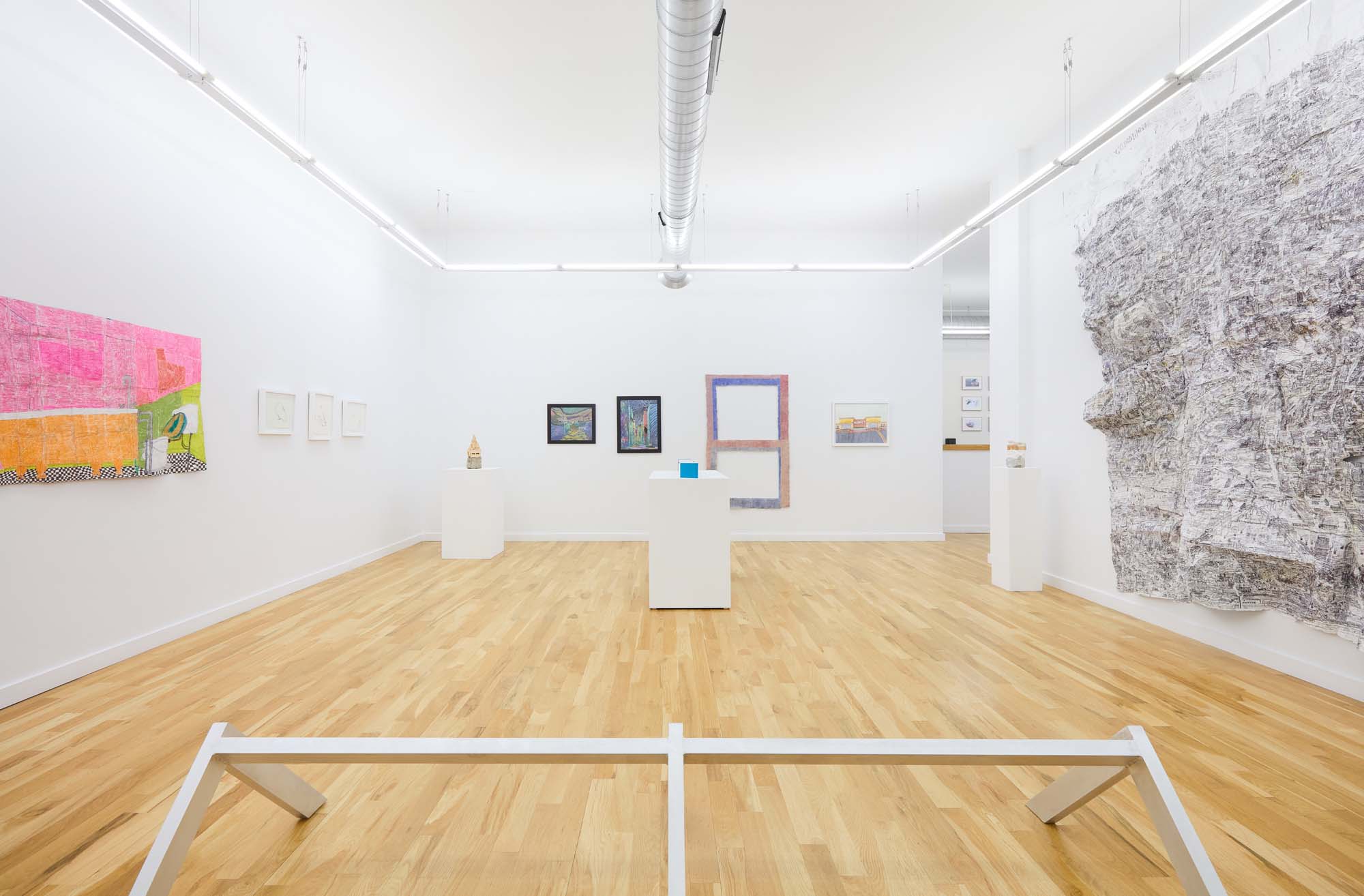
Western Exhibitions is thrilled to present Spaces for People, Systems for Spaces, a group show about the built environment — cities, buildings, structures, urban planning — featuring 15 artists from across the States who make art about architecture.
Reviews:
New City “Western Exhibitions’ New Show Maps Cities, Bodies and the Spaces Between” by Zara Yost | February 26, 2026
Chicago Reader “Art about architecture” by Cassidy Klein | February 17, 2026
The show opens on January 9, 2026, with a public reception from 5 to 8pm and runs through March 21. Gallery hours are Tuesday to Saturday, 11am to 6pm.
Kim Beck (lives and works in Pittsburgh), a multidisciplinary artist whose work explores the everydayness of disaster, is showing a work from her Woven Roads series — photographs of pavement, potholes and road repairs physically woven together. The piece contains images that have been cut into slices and reconstituted in a new, almost illegible weaving, creating a visual plane that has a visual buzz. The ground becomes a flickering surface dissolving before our eyes.
John Behnke’s (b. 1991, lives and works in Chicago) paintings tell complex stories that combine romantic attitudes toward the natural world with dystopian visions of the near future. Painted from memory, based on tangible places, his cityscapes travel between the surreal and hyperreal. He describes his eerie, fluorescent palette as “paranormal colors” and presents most as being at the time of dusk. Behnke works at his home studio in Oriole Park and at Project Onward, both in Chicago.
Marshall Brown (b. 1973, lives and works in Princeton, NJ) is an architect, urbanist, and futurist whose work creates new connections, associations, and meanings among disconnected architectural and urban remnants. We’ll be showing a piece from his Forgeries series, a growing body of work that responds directly to contemporary art’s portrayals of architecture. In these pieces, Brown dismantles photographs by several contemporary artists and reassembles them to create collages that borrow pictorial strategies from the early modern architect and prolific collagist, Ludwig Mies van der Rohe. The Forgeries play a double game. Brown retools Mies’ pictorial flatland as a mirror to reflect contemporary art’s gaze back on itself and constructs new spaces that subvert our attempts to separate the two creative worlds of architecture and art.
Courttney Cooper (b. 1977, lives and works in Cincinnati, OH) draws large elaborate and exuberant maps from his physical and psychological experiences in Cincinnati. Gluing together pieces of found paper from his job at a grocery store, Cooper’s obsessive drawings, rendered with ballpoint pens, map out neighborhoods in his hometown in remarkable detail. Buildings, streets, and conversations are all recorded from memory. Cooper’s work illustrates a sublime moment in time, attempting to understand something as complex as a city. Cooper lives and works in Cincinnati and is an artist member at Visionaries + Voices.
Shir Ende (lives and works in Chicago) is interested in what it would look like if our bodies could become material to build architecture. Ende wants to reposition the choreographer as an architect, enabling them to shape environments by directing movements that define space. Her drawings use a notational system to devise proposals of impossible scores for performances and nonsensical floor plans simultaneously. They imagine a world not limited by gravity and time. Merging flatness and dimensionality, destabilizing the horizon line, alternating perspectives further disorientates the viewer. Ende’s drawings do what a performance cannot: create a record of an articulated space.
Plotted out beforehand using graphite pencil, rulers and protractors, and hand-painted with the illusion of hard-edged precision, Edie Fake’s (b. 1980, Evanston, IL) artistic practice mines the grammar of architecture to carve out space for bodies that have been othered and invalidated by dominant systems of knowledge. Fake’s abstract representations of community form and collapse, cohere and dissipate, reflective of the real experience within queer lives and their ever-shifting constellations, while centering his central concern for the audacity of queer utopian imagining
Using photography, video, notes, and journal texts, Jazmine. (b. 1992, lives and works in Chicago and London) deconstructs and embellishes personal, communal, and social political narratives. Memory, found and fabricated, serves as primary material, while the acts of remembrance inform and shape the processes she employs. In addressing the beauty and failure of collective memory, Jazmine mines, co-creates, and collages archival materials seeking to democratize associated practices, while emphasizing the importance of connection, space, and reimagining the everyday familiar and unknown.
Makayla Lindsay (b. 1995, lives and works in Chicago) is a conceptually driven artist working in performance, sculpture, and video. Drawing from her background as a competitive athlete, her work examines perception, identity, and the cultural forces embedded in bodily movement. Grounded in improvisational and observational gestures, she crafts sculptural arrangements and performance scores that explore our spatial and social relationships to the built environment, emphasizing duration and the shifting role of the audience.
Utilizing fine graphite pencils, pens, and ruler to meticulously render hundreds of constructed lines, R.J. Juguilon’s (b. 1988, lives and works in Chicago) architectural drawings exhibit a thorough consideration of structural minutia. The artist notes, “I really enjoy balance and straight lines. Detail is very important.” R.J.’s architectural work captures the earnest, playful energy of the Windy City.
Aya Nakamura’s (b. 1982, lives and works in Chicago) colored pencil drawings, often on irregularly-shaped handmade paper that she makes in her Chicago studio, are built slowly and through layered applications of colored pencil. Nakamura describes the aesthetic sensibility of these drawings as “magpie,” an attraction to disparate things that compel attention through their distinctiveness or evocative power, and toriawase, a Japanese term referring to the bringing together of varied elements to create a resonant whole. Over the past year, Nakamura’s attention has turned toward features of a home she and her partner have recently moved into, and the human body. What has emerged is a series of drawings that uncovers the uncanny and “creaturely” qualities shared by the built and the bodily, allowing one to stand in for the other.
Brian Petrone (lives and works in Evanston, IL) is an architect, painter, & sculptor whose work deals with the intersection of architecture, painting, and sculpture. Trained as an architect, Petrone employs the processes that go into making a building – forming mass, sculpting space, manipulating light – to create art. Interested in the analogy of the city as a living organism, cities grow, contract, evolve, and change. His sculptures that hang on the wall like paintings include volumes that burst out of the two-dimensional plane, suggesting organic or crystalline growth, mirroring the growth of the city.
Deb Sokolow’s (b. 1974, lives and works in Chicago) semi-abstract schematic drawings focus on the idiosyncratic aspects of (mostly) fictitious built environments while hinting at the concealed agendas and social engineering involved in the design and use of corporate, institutional and domestic architecture.
Ryan Standfest (b. 1974, lives and works in Detroit) is an artist and publisher. Termite-like, with a disregard for illusionism and naturalism, Standfest erodes notions of certainty to bore down into idealism and disillusionment. Uninterested in symbolism, the structures in his paintings depicted are exactly what they are: a building, a tree, a cloud, a rock, a hole, a road. However, these forms populate a rigid, tightly constructed space, not unlike a stage set, where their seemingly inert situational relationships yield a tension between aspiration and forfeiture, order and disorder, meaning and meaninglessness. Indecisiveness is staged in existential, emotionally reticent landscapes where doubt and irresolution are reinforced.
Cathrine Whited (lives and works in Cincinnati) makes deadpan drawings that transform mundane and everyday items into revered icons. Her charming, slyly simple drawings combine image and text to document and archive the world around her, with subjects ranging from household objects to food to cartoon characters. Her process starts with making a list — “What’s in my fridge” or “Things that make up a sandwich” — as a jumping off point. Each item on the list is drawn with graphite and colored pencil, distilled to its essential elements, and labeled underneath, akin to a Victorian-era scientific journals and classifications of nature. Whited is meticulous in this process as an index of erasure is often visible, marking her desire to render the image, and especially the text, perfectly. Her subject-centered renderings are neat, clean, and void of background and are a vehicle for viewers to isolate, experience, and analyze our collective everyday interaction with often overlooked objects and culture that surrounds us.
Born in 1961, Marvin Young is a lifelong resident of Chicago’s South Side who joined Arts of Life’s South Side studio in 2024. Intensely observant and drawing constantly, his works exist as an expression and record of both his community and personal experience over the decades. These quick yet detailed representations of figures and urban landscapes, both imagined and remembered, capture his hometown in a singular voice. His landscapes include elaborately rendered vintage walk-ups, brownstones, brick 4-flats, and residential high-rises—often boasting distinct cornices, bay windows, chimneys, and stoops—typical of his South Side neighborhood. These architectural facades are surrounded by blue skies, traffic signs, brightly hued vehicles (recalling 70s and 80s models), and arching streetlights.
Using his iPad as a reference material, Joe Zaldivar (b. 1989, lives and works in Los Angeles) creates aerial view maps of locations around the world, often autobiographical, as well as street level renditions of the same locations using the Street View function of Google Maps. The resulting works, which combine technology and perspectival architectural drawing in a style reminiscent of cartoon animation, twist time and space both spatially and conceptually. Zaldivar has been an artist with the Tierra Art Studios in Los Angeles since 2011