Skip to content


Stone Figures Mud Drawing

May 14, 2023 - August 13, 2023

Lilli Carré’s practice exists in a revolving conversation between mediums. With exhibitions combining hand-drawn and CGI experimental animation, ceramic sculpture, printed matter, stone mosaic, ink drawings, and weaving, Carré thrives in this orbit of forms that she places in dialogue with each other. Stone Figures Mud Drawing focuses on Carré’s ceramic and mosaic output, with a selection of work across 11 years of an ever-evolving practice. This exhibition is presented at Chicago contemporary art gallery Western Exhibitions’ second location, (northern) Western Exhibitions, in Skokie, IL. It opens with a free public reception on Sunday, May 14, from 3 to 6 pm, and runs through August 13, 2023.

Stone Figures Mud Drawing focuses on the area of Carré’s work created through very physical processes, from earthy materials found low to the ground, and her attraction to the immediacy of working with lumps of wet clay and the deliberateness of cutting and positioning stone. The resulting clay figures and stone mosaics refer to ancient elemental processes and histories, while branching into territory that also pulls from CGI creations and computer logic. The work considers how the human body inhabits, stews and performs in virtual and physical spaces, reflecting on representations of the feminine form, desire, agency, and personal narrative.

Carré’s sculptures and mosaics are materially disobedient. They explore formlessness and caricature as they translate cartoon logic from the virtual to the physical world. She explains that the clay “wants to cave in, to explode, to crack, to shrink, to harden before I’m ready. It has a mind of its own and an active say in its final form. I respond to the play and irreverence of working with mud, in contrast to the fine-tuned control and high level of repetition required in the other mediums I work in – animation, comics, weaving, and recently, stone mosaic. These forms are so ancient but also feel connected to hollow vessel bodies in CGI animation today, both referring to the body but from different directions of tactility. I see the clay form as an extension of the idea of the rebellious cartoon body.”

Carré began working with ceramics in 2012. This new direction allowed for a different kind of intuitive, physical process for her, as she worked within the material’s limitations and her own, embracing a lack of control inherent to the medium. Carré uses a variety of ceramic processes in her sculpture work, including slip and stone inlay, sgraffito, sandblasted etching, and repeated rubbings of terra sigillata on terracotta.

Mosaics are a more recent form for Carré. She started working with this labor-intensive process in 2020, during the lockdowns. The meditative method of creating pixelated imagery with the solidity of stone offered a literal sense of grounding, while researching the history of mosaics that survived various catastrophes over the course of human history. She hand-cut stone chunks into small squares and repositioned the composition many times throughout the process of laying the stones, using mosaic as a way to approach her drawing practice with new constraints, increased physicality, and rhythm.

Carré’s sculptures both imply and defy functionality, as their messages play with contradiction of their mediums. A stone curtain billowing in the wind; bodily vessels suggest mysterious ritual purpose; a metallic, veined, and frayed line climbs across the wall; a pile of severed ceramic tongues lies silenced on the floor; Flat slabs on the wall contain runic inlaid drawings, a visual language on the subject of privacy with marks pulled from Carré’s computer animations; Reimagined chess pieces stand as human-sized sculptures in the gallery on beveled pedestals. While a presence is felt in the relationships between works, there is room for viewers to explore narratives in the interstitial space between them.

Lilli Carré’s solo shows include the Museum of Contemporary Art Chicago, the Columbus Museum of Art in Ohio, Museo Internazionale e Biblioteca della Musica di Bologna in Italy, and Western Exhibitions. She was recently included in Private Eye: The Imagist Impulse in Chicago Art at Indianapolis Museum of Art and Chicago Comics: 1960s to Now at the Museum of Contemporary Art in Chicago. Her animated films have been shown in many festivals nationally and internationally, including Sundance, Annecy, and IFFR in Rotterdam. She co-founded the Eyeworks Festival of Experimental Animation in 2010, which is held annually in Chicago, Los Angeles, and New York. She has several published graphic novels with Fantagraphics and her work has appeared in The New Yorker, Best American Comics, Best American Nonrequired Reading and the New York Times. Carré received a BFA from the School of the Art Institute of Chicago and MFA from Northwestern University and is represented by Western Exhibitions in Chicago. She currently lives and works in Los Angeles and teaches in the Experimental Animation department at CalArts.


Read a review of Stone Figures Mud Drawing in NewCity Art by Vasia Rigou at this link.

________________________________________________________________

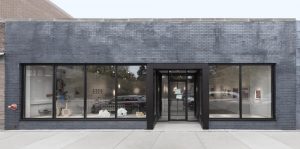
This exhibition is presented at Chicago contemporary art gallery Western Exhibitions’ second location, (northern) Western Exhibitions, in Skokie, Illinois. This suburban space expands on the Chicago location’s programming with approximately five specially curated exhibitions a year featuring works by artists from the gallery’s 20-year history. (northern) Western Exhibitions shares a renovated single-floor bow truss building on Skokie’s charming downtown corridor with WHO Modern, a mid-century modern-focused vintage store co-run by Donald Schmaltz and building owner Zach Williams.

(northern) Western Exhibitions and WHO Modern are located at 7933 N Lincoln Ave, Skokie, IL 60077.
Gallery hours are Wednesday through Saturday 12-6 pm, and Sunday 12-4 pm.
For interviews, images, or more information, please contact Scott Speh at (312) 480-8390 // scott@westernexhibitions.com


Photography

February 11, 2023 - May 6, 2023

Download an enhanced PDF here.

Inquire about available work here.

Review in the Chicago Reader

Review in New City

PERFORMANCE: Miller & Shellabarger will perform Untitled (Pink Tube) from 12 to 4pm on Sunday, April 16 (the last day of EXPO Chicago week). This non-theatrical performance is free and open to the public, stop by anytime between 12 and 4pm.

Married artist collaborators Miller & Shellabarger use self-portraiture, laborious material processes, and considered craftsmanship to meditate on love and death, across a myriad of media. The possibilities of connection, partnership, interdependency, and the eventualities of loss penetrate the objects and enactments of their work. While known primarily for how they adopt traditional American craft techniques, including silhouette cutting, sewing, crocheting and bookmaking, Miller & Shellabarger: Photography focuses on the role photography plays in their ongoing projects dating back to 2005 and extending to the present. This exhibition is presented at Chicago contemporary art gallery Western Exhibitions’ second location, (northern) Western Exhibitions, in Skokie, Illinois and opens with a free public reception on Saturday, February 11 from 5 to 8pm and runs through May 6, 2023.

The artists’ most recognized artwork is the performance Untitled (Pink Tube), an ongoing non-theatrical performance begun in 2003. It is a lifelong artwork, publicly performed together, in which they simultaneously crochet at opposite ends of a long tube of pink yarn. The artists have agreed that when one of them is no longer able to perform, the other will unravel the tube, in public. As the object itself will never be made available for sale, the artists periodically produce photographs of the performance, the first one taken in 2005 at The Suburban, an artist-run gallery helmed by Michelle Grabner and Brad Killam, in Oak Park, Illinois. The third photograph of the performance was taken in 2013 on the steps of the Museum of Contemporary Art in Chicago, during an exhibition there marking 10 years since the piece was initiated. The fourth photograph, from 2015, documents a performance on and around the tree on which they were married in Palmer Square Park in Chicago.

The show will present other photo-documented performances. In Untitled (Origami Cranes), the artists folded paper into origami cranes over the course of three Saturdays, eight hours at a time, on a bed in the window of a Chicago futon store. Two iterations of Untitled (Grave) will be shown, one from Basel, Switzerland, the other from Portland, Oregon, in which they dug, in close proximity to one another, two holes, deep and large enough for each man to lie in. Upon completion of the holes, they then bored a small tunnel between them so their hands could clasp underground and out of view. The photo-driven artist books Sewing Books document Untitled Performance (Sewing), a piece in which the artists repeatedly stitched and unstitched, while sitting against one another, the garments they were wearing from ankle to neck over the course of the day. Additionally included are the Seed photographs which capture the outline drawings they made of each other’s bodies using sunflower seeds. Executed outside, after documentation, the seeds were simply left to let nature and the forces of entropy take their course.

Some series in this show are not performance documentation but conceived wholly as photographs from the start. Their Tintype series queer the history of this media by explicitly depicting their relationship, as opposed to vintage tintypes, where men were often seen arm in arm, arms around shoulders, or even sitting in one another’s lap, their sexual orientation seemingly ambiguous. In the Spooky Distant Action series, images of each artist twirling in space with lit sparklers at dusk were overlaid atop one another, akin to a multiple exposure photograph. Mimicking spooky distant action—the quantum entanglement of two particles ensures their connection, even at great distance— the artists’ bodies whirled in tandem, creating a particle trace of their two mirrored selves. The Erasure series involves in situ magic-eraser drawings of the artists’ intertwined initials, “S&M.” Miller & Shellabarger made a stencil of this cypher and overlaid it atop resonant spaces in their shared home – their desk, the kitchen, the wall that abuts their bed – and erased through the stencil the accumulation of their daily life (dust, dirt, etc.), imprinting the monogram into their shared existence.

Miller & Shellabarger have had solo shows at the Museum of Contemporary Art, the Chicago Cultural Center, and the Hyde Park Art Center, all in Chicago and at INOVA in Milwaukee, the University Galleries at Illinois State University, The Carnegie in Greater Cincinnati, and Gallery Diet in Miami. They have performed and have been exhibited in group shows across North America, including the Pulitzer Arts Foundation in St. Louis; the Contemporary Art Center in Cincinnati; the Time-Based Arts Festival in Portland, Oregon; Andrew Edlin Gallery, New York; Sun Valley Center for the Arts in Idaho; Institute of Contemporary Art in Maine; and Sala Diaz in San Antonio. Miller & Shellabarger are a 2008 recipient of an Artadia Chicago award and a 2007 recipient of a Louis Comfort Tiffany Foundation award. Their work is in the collections of the Art Institute of Chicago, the Nerman Museum of Contemporary Art, the DePaul Art Museum, the Newark Public Library, Eskenazi Museum of Art at Indiana University and the National Gallery of Canada. Their work has been written about in Artforum, Art in America, Art & Auction, Frieze, Artnet, The Art Newspaper, Flash Art, Chicago Tribune, and the Chicago Sun-Times. Dutes Miller and Stan Shellabarger also maintain separate artistic practices. They live and work in Chicago.


This exhibition is presented at Chicago contemporary art gallery Western Exhibitions’ second location, (northern) Western Exhibitions, in Skokie, Illinois. This suburban space expands on the Chicago location’s programming with approximately five specially curated exhibitions a year featuring works by artists from the gallery’s 20-year history. (northern) Western Exhibitions shares a renovated single-floor bow truss building on Skokie’s charming downtown corridor with WHO Modern, a mid-century modern-focused vintage store co-run by Donald Schmaltz and building owner Zach Williams.

(northern) Western Exhibitions and WHO Modern are located at 7933 N Lincoln Ave, Skokie, IL 60077.
Gallery hours are Wednesday through Saturday 12-6pm, and Sunday, 12-4pm.
For interviews, images, or more information, please contact Scott Speh (312) 480-8390 // scott@westernexhibitions.com


Mirror and Bone

March 3, 2023 - April 22, 2023

For his fifth solo show at Western Exhibitions, Richard Hull presents new paintings of bulbous, energized abstracted figures, broadening the amorphous heads and hairstyles he’s depicted for the past several years into fully-formed characters. Before graduating from the School of the Art Institute in Chicago in 1979, Hull joined the legendary Phyllis Kind Gallery, the primary dealer of many of Chicago’s Imagist artists. At the time, his paintings were known for their abstracted architectural interiors. More recently, Hull has returned to the loose-limbed figuration of the Imagist era. Considered more romantic and painterly than his forebearers, his repetitive gestures and inscriptions limn reverberating abstract heads and bulbous hairstyles. Imagining these abstract portraits to be inner mirrors, containers in which repetitive thinking and behaviours are visualized, Hull has now added bodies and limbs. Utilizing both gallery 1 and 2 at the Western Exhibitions Chicago location, this show opens on Friday, March 3 with a free public reception and runs through April 22, 2023. Gallery hours are Tuesday to Saturday, 11 to 6pm.

In gallery 1, Richard Hull’s newest paintings and drawings depict multiple figures in various enigmatic tableaus, born of frenetic marks that somehow coalesce into coherent scenes or events. Are the figures in conversation? Confrontation? The narratives are slippery with senses of disorientation, discombobulation and vertigo. Compositions are complex, influences run deep (Max Beckmann, Philip Guston, H.C. Westermann to name a few) and his techniques utilize his vast index of pictorial tools. Whereas Hull’s earlier “stolen portraits” paintings relied upon interaction with the viewer, the characters are now more autonomous, free to interact within the painting plane, and sometimes are even a little naughty. This change came about, to quote the artist, “simply from a desire to have the characters stand up, literally.” The color pink dominates the five paintings on view in gallery 2. It is an intense pink that belies the notion that pink is soft and nonaggressive, so strident is Hull’s hue. The paintings are in conversation with each other about how very similar things might still maintain a uniqueness of character. The pink is the same pink in each painting.

Richard Hull has paintings, drawings and prints in the collections of several museums including the Art Institute of Chicago; Museum of Contemporary Art, Chicago; Smithsonian Museum, Washington, D.C.; Nerman Museum of Contemporary Art, Kansas; Museum of Fine Arts, Houston and the Smart Museum, Chicago. He has exhibited his work at many of the above institutions as well as at the Nelson-Atkins Museum of Art, Kansas City, MO; the Aldrich Contemporary Art Museum, Ridgefield, CT; Contemporary Arts Center, Cincinnati, OH; Portland Art Museum, OR; the Cleveland Institute of Art, Cleveland, OH; Herron Gallery of Art, Indianapolis, IN; Cranbrook Academy of Art, Bloomfield Hills, MI; Mary and Leigh Block Museum of Art, Evanston IL; and the Painting Center, New York, NY. He lives and works in Chicago.

Read a review of Mirror and Bone by John Yau in Hyperallergic here: https://hyperallergic.com/809642/richard-hull-completes-the-picture/or download a PDF version here.

Read a review of Mirror and Bone by Alan Pocaro in NewCity here: https://art.newcity.com/2023/03/14/full-body-sensation-a-review-of-richard-hull-at-western-exhibitions/  or download a PDF version here.

Watch a video walkthrough with a narrated version of the above press release:


The 2023 Western Exhibitions Drawing Biennial

January 6, 2023 - February 25, 2023

Western Exhibitions is thrilled to present the second Western Exhibitions Drawing Biennial, a celebration of the medium of drawing in many expanded mutations. Contributions by gallery and affiliated artists confirm the gallery’s commitment to drawing and works on paper and the varied approaches on view — from schematic to free-form, in-your-face to speculative, abstract to figurative — will capture the current state of contemporary drawing practices while placing a focus on gallery artists’ core concerns of personal narratives and cosmologies, identity and gender, sexuality, pattern and exuberance, all with a keen attention to materiality. The inaugural WXDB, in 2021, presented multiple works from each artist. This iteration is different: participating artists will present just one or two pieces – some created specifically for this show, others pulled deep from within the artist’s archive – to concentrate the viewer’s focus and reward careful looking. By continuing the idea of a Drawing Biennial, Western Exhibitions stakes a claim that drawings are to be lauded as much as painting, sculpture, and any other medium, as the gallery reveres the handmade, the tactility, the immediacy of drawing. From the essay by Shannon R. Stratton, commissioned by the gallery for the 2021 show: “Drawing is space to make visible the contents that make us, to make material, and then examine, those qualities that are much more complex than the linguistic code applied to them.”

Critic Erin Toale reviewed the inaugural Western Exhibitions Drawing Biennial in New City, expertly capturing the gallery’s devotion to the practice of drawing:

Drawing. A medium that is foundational, yet often relegated to the planning stages: just a sketch, rarely the main event or finished product, something unearthed after the death of an artist or architect to demonstrate their rendering accuracy. This biennial, however, is not drawing as a first draft, a prompt, or the beginning of something. This is the gallery declaring its commitment to drawing in a public ceremony. This is the evolving mission and history of the space as told through multiple panoramic storyboards, each artist with a vignette contributing to the overall narrative.

The Western Exhibitions Drawing Biennial will open the 2023 art season with a reception, free and open to the public, at our Chicago location on Friday, January 6, from 5 to 8 pm and will run through February 25. Gallery hours are Tuesday to Saturday, 11am-6pm and by appointment.


Read a review of the show by Lori Waxman in HYPERALLERGIC here.

Access an enhanced PDF to see available work and details here.
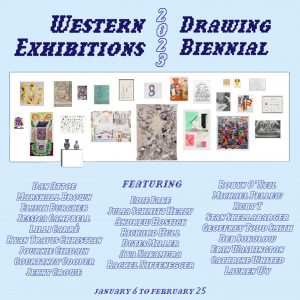
Participating artist bios:

Dan Attoe’s paintings depict natural wonders populated by tiny figures spouting even tinier diaristic missives culled from the artist’s stream of consciousness. Attoe makes a small drawing every day that he keeps for himself—slightly larger drawings and paintings expand upon this practice. His drawings share the same concerns but inverted—the phrases and disconnected images are larger and often cartoonish, creating small-scaled narrative vignettes.

Marshall Brown is an architect, urbanist, and futurist whose work creates new connections, associations, and meanings among disconnected architectural urban remnants. Moving between various scales of architecture and diverse conceptual frameworks, Brown’s collages embody new relationships between the one and the many as he expands the boundaries of reality.

Elijah Burgher creates structured, hieratic compositions in his coloured pencil drawings, matching figuration to abstraction in a provocative tension. A simplified approach to pencil technique and colour along with an attention to paper as a light source allows for heightened luminosity.

Jessica Campbell’s satirical drawings, comics, and textiles expose the everyday experiences that reveal the sexism women have faced throughout history, and especially presently. She infuses a vulnerably humorous tone into her work, but underlying this humour is often a darker subject matter that directly or indirectly references themes of class oppression, sexual violence, gender discrimination, trauma, or other personal narratives.

Lilli Carré’s interdisciplinary creative practice employs a wide range of media including drawing, animation, comics, printmaking, and ceramic sculpture. Representations of the malleable animated female body throughout history are a constant source of fascination for Carré.

Ryan Travis Christian carefully and densely layers graphite to reveal high-contrast graphics and dizzying patterns in his small-scale drawings. Impacted by Chicago-style figuration, Christian focuses on the paradoxical relationship between childish cartoons and ominous messages, musing on the technological and material obsolescence of his inspiration.

Journie Cirdain thinks of the drawing surface as a locus for thoughts, puns, personal narrative, scraps of information, remembered art history, daydreams, desires and other tangled remnants of everyday life to become magically visual.  Often, these drawings are directed by a word, object, or the artist’s actual body, which is placed, like a stone, into the center of the surface. A wide range of scratches, scribbles, smears, and detailed drawing techniques reveal the system of connections which ensue.

Courttney Cooper is a vernacular artist from Cincinnati, Ohio who is known for drawing large-scale cityscapes of his hometown that respond to changes in the city’s architecture and environment. Cooper’s practice is a perpetual celebration of Oktoberfest Zinzinnati, USA, a commemorative and nostalgic place that exists parallel to or as a transparent layer upon Cincinnati, Ohio.

Jenny Crowe uses fragments of truth and information to create visually complex and powerful images. Somewhere in between poetry and painting, Crowe’s words are layered and overlap enough to visually flatten themselves. She works methodically from left to right and top to bottom filling the void of empty space until the viewer is trapped somewhere between the impulse to read and a purely visual experience.

Edie Fake’s precise paintings and drawings start as self-portraits. From there, they make a break for it as Fake references elements of the trans and non-binary body through pattern, colour, and architectural metaphor. His intimately scaled gouache and ink paintings on panel are structured around the physical aspects of transition and adaption as well as mental and sexual health.

Julia Schmitt Healy’s early work embodies the Chicago Imagist scene in the early 1970s. Her drawings on handkerchiefs and sewn flour bags present connections to real people, places and things through a lens of symbolic surrealism. Her work focuses on themes ranging from ecological disaster, human relationships, symbols, feminism, consumerism, and the natural world.

Andrew Hostick is self-taught, taking as his subject the advertisements and reproductions found in various art magazines including Art in America and Artforum. In each drawing Hostick inscribes and scores the mat board with heavy-handed marks, slowly building up a velvety sheen of coloured pencil. The resulting works constitute a beautiful collapse of both primitive and contemporary sensibilities, commenting directly on a sort of voyeuristic access to an Art World largely inaccessible to the artist as an outsider practitioner.

Richard Hulls crayon drawings curate conversations between colour and form. Hull’s portraits and hairdos express distinct visual personalities rather than legible representations of specific individuals. He calls his over-capacitated, robust, mysterious heads “stolen portraits.”

Dutes Miller examines the spaces where the artist’s inner life, queer subcultures, and mass media intersect in his collages and artist books. Appropriating images from pornographic websites, magazines, and his own imaginings, Miller investigates alternative standards of beauty, visualizations of lust and desire found on the internet, and power dynamics in sexual relationships. His work critically engages with the mythologies surrounding human sexuality, especially the exploration of the male body as it manifests itself in gay desire—in its evident state of arousal, its protuberances, and its emissions.

Aya Nakamura’s work is influenced by a philosophy of mind, derived from interacting with plants and following post-humanist research in biology and anthropology, that does not exclusively locate consciousness in the human. Variegated lines move across, alongside, and info fields of colour in Nakamura’s coloured pencil drawings on handmade paper of different sizes and shapes. Some have visual links to existing symbols and objects which provide starting points and themes within amorphous compositions, simultaneously building and dissolving the more time is spent exploring the compositions.

Rachel Niffenegger’s work focuses on the ephemeral state of the feminine figure in contemporary society, addressing notions of the body, sculpture, clothing, and painting. She allies to both physical and psychological violence in her stained fabrics, horror-themed watercolour paintings, and mixed media sculptures; all preoccupied with fecundity and the macabre, Niffenegger’s drawings are at once psychedelic and mysterious.

Robyn O’Neil’s precisely drawn graphite landscapes investigate evolution, apocalypse, natural disaster, and extinction with imagined imagery that is surreal, and separate from the flow of time. Ominous clouds and landmasses, monks, ears, mysterious female figures, faceless busts, and other enigmatic characters float over craggy and rolling landscapes illuminated by strange—almost heraldic—light, cast through mystical clouds, calling to mind Pre-Renaissance painting.

Michael Pellew is a Brooklyn-based artist who is known for his humorous rumination on pop culture and celebrity mash-ups. His inspiration comes from speed metal, Taylor Swift, Chicago Deep House and reality TV stars. Michael’s seemingly simple and succinct drawings use playful line quality and imaginative cultural observations to develop an alternate universe where pop culture is thrown into a blender, giving the viewer random moments that are exuberant, painfully honest, witty and at times, grim.

Stan Shellabarger‘s drawings in the Western Exhibitions Drawing Biennial are made by walking on paper laid over an aggressive surface while wearing shoes with graphite-impregnated soles, a tangible extension of his endurance-performance actions, often enacted from sunrise to sundown on solstices and equinoxes. Shellabarger’s performances, works on paper, prints and artist books employ alternative drawing methods to address how the body relates to the Earth. He takes everyday activities—walking, writing, breathing—to extreme measures in endurance-based performance work that amplify the traces humans leave on the Earth. Repetition of an activity leads to a massive accumulations of marks, thus creating drawings that record discrete units of time and space. This repetition is necessary so that otherwise extremely subtle marks emerge as visible artistic interventions.

Geoffrey Todd Smith creates complex, rule-based abstractions that place him firmly within the orbit of modern American art, but with a wandering eye to the future. His vision is guided by self-imposed limitations that instill order to an otherwise meandering dream-like process. The result is a stylish eruption of concentrated color and form, enveloped in a hand-drawn web of doodled spikes and ruffles and embedded with a rhythmic plague of polka-dotted interference. The playfully constructed titles for each work provide an additional climate of atmosphere and mood without completely revealing a narrative.

Deb Sokolow’s semi-abstract diagrammatic drawings reference aerial views and floor plans. Their titles propose humor and criticality with regard to the built environment, institutions and the foibles of world leaders. Sokolow’s schematics often appear to be reproduced with a printmaking process. Instead, they are hand-rendered with colored pencils and crayons and function as a conceptual compliment to their speculative titles in that they contain a level of uncertainty with regard to the fabrication of content.

Ruby T is a drawer who is fuelled by anger, desire, and magic. Her practice is equal parts performative and devotional, and her drawings and marbled silk paintings are translations of political and sexual desire. For the past few years, she has been preoccupied with drawing moving water —particularly the impossible act of representing it— landing recently on the process of marbling, which essentially is a print of the surface of water.

Erin Washington’s paintings and drawings combine imagery, text, and fugitive materials to evoke a long history of human inquiry into the form and meaning of the universe we live in. In these works, perception, and permanence are called into question, while elements of theoretical physics mingle with images of tangible objects from antiquity. These multilayered works consist of a medley of ambiguous scientific diagrams, art historical references, Post-it notes, studio debris, mythological figures, and self-deprecating jokes.

Cathrine Whited writes lists as the first step in her art-making process.  She then draws each item on the list, rendered in her unique way of framing and labeling the item before cataloging the list’s drawings together as a unit.  For instance, with a list entitled, “What’s in my fridge?” every possible item that is in the fridge is labeled. She starts a drawing with a ruler, making guidelines in pencil, to then render the imagery and text.  Colored pencil is then applied for the right amount of color before moving to the next item on the list. Her renderings are a vehicle for viewers to isolate, experience, and analyze our collective everyday interaction with the objects and culture that surrounds us.

Lauren Wy practice is rooted in the anarchy and immediacy that can be located in expressive mark making, utilizing acid color and expressive figuration to investigate obsession and possession, ritual submission and dominance, alienation and presence. The materials and formal elements of her images work as a method of reduction into the base elements of our collective psychological condition, asking questions of control and self authorship. Ultimately it is always brought back to desire and the power structures that code the
formation of selves as evident in the constant slippages between figure and abstraction

Sweet 16: 16 Years of Geoffrey Todd Smith at Western Exhibitions

November 12, 2022 - January 29, 2023

 BlChicago contemporary art gallery Western Exhibitions is thrilled to announce the opening of a second location, (northern) Western Exhibitions, in Skokie, Illinois. This suburban space will expand on the Chicago location’s programming with approximately five specially curated exhibitions a year featuring work by artists from the gallery’s 20-year history.

(northern) Western Exhibitions will open on November 12 with a celebration of the gallery’s 16+ year relationship with Chicago-based artist Geoffrey Todd Smith. Known for his highly detailed abstractions, Smith creates complex, rule-based pieces that place him firmly within the orbit of modern American art, but with a wandering eye to the future. Sweet 16: 16 Years of Geoffrey Todd Smith at Western Exhibitions opens November 12, 2022 with a free public reception from 5 to 8pm and runs through January 29, 2023, at (northern) Western Exhibitions.

For Sweet 16, the gallery will present one work from each of the 16 years Smith has shown at Western Exhibitions. The gallery first showed his colorful, geometrically abstract gel-penned drawings at Art Chicago at the Mart in 2006. Smith’s first solo show then opened at the gallery in 2007, featuring intensely detailed drawings that mixed euphoric and discordant hand-drawn imagery in equal measure, enticing viewers into fields of beautiful psychedelic patterning only to reveal wickedly spiked and thorny shapes. Sweet 16 will include one of Smith’s most recent pieces, Maximum Saxophone, a painting on panel from his 2021 show Sordid Orchestra. In this series, each work begins with one continuous, wavy line, meandering throughout the picture plane, until it ends back where it started. In a complicated juggling act of materials, Smith integrates a variety of mediums including acrylic, enamel, gel pens, gouache and oil-based paint markers, on both paper and wooden surfaces while taking viewers’ eyes on a hue-saturated rollercoaster ride of pulsating pattern, undulating curvaceous forms and fetishistic mark-marking.

(northern) Western Exhibitions has commissioned an essay specifically for the show, available as a take-away at the gallery, by Chicago expat Dominic Molon, the Richard Brown Baker Curator of Contemporary Art at the RISD Museum in Providence, Rhode Island. From an excerpt of “A dot, a line, and a pattern walk into a bar …” Molon writes:

“A painting such as Show Me All of Your Piercings and I’ll Tell You All of My Dreams possesses a stoic restraint in its use of white, black, gold, gray, and brown, and tightly alternating patterns. Contrast this with the fluidity and off-centeredness of Unmemorable Tryst with a Hypnotist, which layers differently patterned circular, ovoid, sunburst, and square forms (among others) with curving lines of varying thickness in a seemingly inchoate jumble. Philip Glass meets David Lee Roth … Stephen Wright meets Sam Kinison … Michael Snow meets Mel Brooks and so on. Smith fascinatingly alternates the personality of his paintings within his own oeuvre, making the inconsistency of their temperament and tone an absolute constant in his practice.”

Geoffrey Todd Smith (b. 1973, Cleveland, OH) has work in the collections of the Art Institute of Chicago, Santa Barbara Museum of Art, The Federal Reserve Bank of Chicago, The Progressive Insurance Art Collection, Hallmark Inc., Fidelity Investments Corporate Art Collection, the Jager Collection in Amsterdam, Soho House Chicago, the South Bend Art Museum in Indiana, and Harper College in Illinois. His work has been shown at Luis de Jesus Gallery and Charlie James Gallery in Los Angeles; Hyde Park Art Center, the Union League, DePaul Art Museum and Shane Campbell Gallery in Chicago; The Hughes Gallery in Australia; The Green Gallery in Milwaukee; The Front in New Orleans; Illinois State Museum, and the Elmhurst Art Museum in Illinois. He has been written about in New City, The Seen, New American Paintings, Bad at Sports, art ltd, Juxtapoz, Chicago Tribune, and Chicago Magazine. Smith lives and works in Chicagoland.


Download “A dot, a line, and a pattern walk into a bar…” by Dominic Molon, written on the occasion of this exhibition, here.

___

(northern) Western Exhibitions and WHO Modern Bring Contemporary Art and Vintage Design to Downtown Skokie

The Newly Renovated Building that Houses Both Spaces Opens on November 12 with an Exhibition by artist Geoffrey Todd Smith

(northern) Western Exhibitions will share a renovated single-floor bow truss building on Skokie’s charming downtown corridor with WHO Modern, a mid-century modern-focused vintage store co-run by Donald Schmaltz and building owner Zach Williams. As a vintage veteran with a love for Italian furniture, Schmaltz previously co-owned Chicago’s Circa Modern and has worked as a design specialist at Toomey & Co. Auctioneers and Leslie Hindman Auctioneers. In addition to curating furniture and designed objects at WHO Modern, Schmaltz will also oversee day-to-day operations at (northern) Western Exhibitions.

(northern) Western Exhibitions and WHO Modern are located at 7933 N Lincoln Ave, Skokie, IL 60077. Street parking is available. Gallery hours are Wednesday to Saturday, 12-6pm and Sunday, 10am- 3pm.

.


Geoffrey Todd Smith Will Romance You When He Is Good And Ready!

September 8, 2007 - October 6, 2007

Geoffrey Todd Smith’s abstract drawings mix beauty and danger in equal measure, enticing viewers into fields of beautiful psychedelic patterning only to reveal wickedly spiked and thorny shapes. As viewers, we recall the moments when we began asking questions like: Why are my parents inspecting my Halloween candy?  What was that high school boy in the Ace Frehley t-shirt distributing on the playground if not stickers? Influenced by nature documentaries on gorgeous carnivorous plants, great white sharks, and razor-sharp coral reefs, these colorful and trippy hand-made drawings are both seductive and threatening.

Smith uses a series of small geometric shapes to form fields of brightly colored images drawn with gel pens on a variety of colored papers, often including collaged elements or shapes painted in gouache. This limited vocabulary of mark-making presents a range of images that evoke a mood of sentimentality for activities of his youth: jigsaw puzzles, video games, sticker collections, and doodling as well as his youthful fascination with simple geometry and one-point perspective.

A key drawing in the show, “Please Don’t Lick the Pollock,” was inspired by a story Geoffrey was told about a girl who had the odd desire to lick a Jackson Pollock painting on a trip to a Washington D.C. museum, a story that made him want to arouse a visceral response to the viewing of his work. Hence, Geoffrey Todd Smith will reward the patient viewer by turning them on!

In 2007 Geoffrey Todd Smith was included in “The Uncertainty Principle: Drawing in the Golden Age of Worry” at the Northern Illinois University Art Museum and in “Obsessive-Explosive” at the Evanston Art Center in Illinois. Recent shows include a solo at ButcherShopDogmatic in Chicago and group shows at Telephone Booth in Kansas City, Mixture Contemporary in Houston and SUNY-Purchase in New York Smith has work in the collections of Hallmark Cards, Inc. in Kansas City, the South Bend Regional Art Museum and Harper College in Illinois. He was featured in the April 2007 issue of Chicago Magazine as one of Chicago’s “rising stars we should be collecting now” and his work has been written about in artinfo.com. Smith lives and works in Chicago.


when there is no sun

September 16, 2022 - October 29, 2022

For his second solo show at Western Exhibitions, Daniel Rios Rodriguez presents a new group of paintings about summer, a hot hot hot summer. Painted suns feature prominently in Rodriguez’ recent work but these paintings might be his least symbolic yet. Driven by the landscape and the intense heat of this summer, this body of work is about the sun in a very literal way. Making work in the Texas heat, in a studio without A/C, he’s only been painting in the mornings and mostly outside, saying that “making these paintings is kind of like taking a vacation where you are cramming in a lot in a short amount of time. They are also about portability since the paintings are living mostly on my fence outside and spending a bit of time with me on the river. Rarely am I taking them into the studio to work where it feels like an oven.”

Rodriguez’ shaped canvas paintings, unique combinations of found material and impasto paint executed on an intimate scale, take inspiration from his environment, his children, and his dreams. Rodriguez makes the supports himself from materials such as terracotta and cement and lades the paintings with flotsam he finds within the natural landscape.

This is Daniel Rios Rodriguez’ second solo show at Western Exhibitions; his first, in 2016, was reviewed in Art in America. Critic Kyle McMillan wrote “”Daniel Rios Rodriguez’s quirky, unassuming paintings don’t fall into any easily recognizable niche or category… With their homemade and found wood frames, their collaged elements (shells, river rocks, feathers), and their deliberately unrefined paint-handling, these works have a rustic, do-it-yourself feel.” Though his work is informed by the canon of European Modernism and art historical painting, the artist looks equally towards peripheral figures like the visionary Texan painter Forrest Bess.

Daniel Rios Rodriguez’ museum exhibitions include the San Antonio Museum of Art, San Antonio (2019); Palais de Tokyo, Paris (2019); the Contemporary Arts Museum Houston, Houston (2018); McNay Art Museum, San Antonio (2015); and White Columns, New York (2011). Select gallery exhibitions include Cooper Cole (2022), Various Small Fires, Dallas (2022); Kerlin Gallery, Dublin (2021, 2018); Camden Art Centre, London (2020); Nicelle Beauchene Gallery, New York (2020); i8 Gallery, Reykjavik (2018); Galeria Fortes D’Aloia & Gabriel, São Paulo, Brazil (2017); Lulu, Mexico City (2016); Hannah Hoffman Gallery, Los Angeles (2016); Western Exhibitions (2016) James Harris Gallery, Seattle (2015); and Martos Gallery, New York (2013). He was a recipient of a 2013 Louis Comfort Tiffany Foundation Award. Rodriguez (b. 1978, Killeen, Texas, USA) received a BFA from the University of Illinois at Chicago in 2005, an MFA from Yale University in 2007 and lives and works in San Antonio, Texas, USA.


Watch a narrated video walkthrough of the exhibition below:


Act Natural

September 10, 2010 - October 9, 2010

Western Exhibitions kicks off the fall season with “Act Natural”, a solo exhibition by JOEY FAUERSO in Gallery 2. Fauerso will show two videos and figurative watercolors on paper that combine landscapes and figures, exploring a grey area between fantasy and reality. “Act Natural” will open on Friday, September 10 with a free reception that is open to the public from 5 to 8 pm.

Over the past few years, Fauerso has been working on a series of hand-painted animations that represent different kinds of physical and metaphorical transcendence. She draws from the histories of painting, dance, and performance art while utilizing digital animation tools to explore the nature of human consciousness. The two videos in this show introduce live-action to her work.

“Me Time” is an eight-minute video showing Fauerso making out with a series of puppets, including a firefighter, a policeman and a construction worker. She attempts to make as “real” a connection as possible with the ridiculous-looking puppets.

“Clearing”, a three-minute video, superimposes live figures over antique wallpaper depicting a forested grove. Fauerso plays a flute in this forest and her music seduces a young naked man who twirls around until he collapses, while flocks of animated birds fly overhead. Fauerso is interested in challenging the history of images that equate the female body with nature: women as vulnerable, sexual creatures. Fauerso flips this script; in her paintings and videos, the male doesn’t control or dominate the landscape but is depicted as both vulnerable and erotic.

Her watercolor paintings of lone figures being erased or subsumed by a void marry the process of painting with the painted figure, continuing her theme of joining the real and the illusory.

This is Joey Fauerso’s second show with Western Exhibitions. Her paintings, works on paper, and animations have been shown at the San Antonio Museum of Art, David Shelton Gallery, Finesilver Gallery, and Sala Diaz, all in San Antonio, the Roswell Museum of Art in New Mexico, and the Arlington Museum of Art in Texas. Her artist residencies include the Serie Project Residency in Austin, TX, Hotel Pupik in Austria, Korpulfsstadir Residency in Reykjavik, Iceland, and the Roswell Artist in Residence in New Mexico. She received her MFA in 2001 from the University of Wisconsin-Madison. Fauerso lives and works in San Antonio, Texas.

Western Exhibitions would like to thank the Interactive Arts & Media Department at Columbia College Chicago for technical assistance with this show.


It is easy, It is good

October 28, 2006 - December 2, 2006

Joey Fauerso will show It is easy, It is good, a projected animation and a series of drawings from the animation’s construction. Her animations start with her filming a closely cropped human figure directed to perform a specific action (e.g. screaming or reading a poem). She then breaks down the video into individual frames, focusing on actions and movements that are involuntary. She paints these individual frames and films the paintings, thus slowing down the figures’ movements in the resulting projected animation. The individual paintings and the animation are exhibited together, juxtaposing two representations of a single event: one organized spatially in a grid, the other temporally in a real-time animation.

Fauerso’s paintings, animations, and works on paper use the figure to provoke an awareness of space and the body in viewers. She states that she is interested in using representation, and the framework for that representation (whether it be white paper, a grid, or a found landscape), as a way to present shifting or contradictory perspectives.

Joey Fauerso recently completed a year-long residency in Roswell, New Mexico that culminated in the show If I’m Thinking I’m Probably Feeling at the Roswell Museum of Art. She has impending solo shows in 2007 at the Arlington Museum of Art and Finesilver Gallery in San Antonio and her work has been discussed in Flash Art, Art US, and Art Papers. She lives and works in San Antonio, Texas.


Bed-Stuy to Chi: Artists from LAND Studio & Gallery

April 29, 2022 - June 18, 2022

Raquel Albarran
Carlo Daleo
Garrol Gayden
Kenya Hanley
Byron Smith
James Rosa

Western Exhibitions is thrilled to present Bed-Stuy to Chi: Artists from LAND Studio & Gallery, a group show of artist from one of favorite progressive art studios, LAND Studio & Gallery. Founded in 2005 and located in the Bedford-Stuyvesant neighborhood of Brooklyn, LAND is a unique nonprofit day-habilitation program that teaches life skills through the modality of art, nurturing the talents of participating artists, while integrating individuals into the community of contemporary art. Bed-Stuy to Chi, a companion exhibition in Gallery 2 to fellow LAND artist Micheal Pellew’s solo show in Gallery 1, features drawings and paintings by Raquel Albarran, Carlo Daleo, Garrol Gayden, Kenya Hanley, Byron Smith and James Rosa. The show opens on Friday, April 29 with a public reception from 5 to 8pm, and runs through June 18, 2022.

Raquel Albarran (b. 1987) is a Puerto Rican born artist living and working in Brooklyn, New York. Preoccupied with toes, noses, and encapsulated forms, Albarran’s art is full of juxtapositions and playful explorations of life, illness, and objects begging to be squeezed. Albarran’s drawings and sculptures reflect her delight sense of mischief, humor, and energy. Albarran describes the fantastical and sometimes bizarre pairings in her work are as an endearing “mix of light and dark”. She warns viewers that there will be “a lot of amputations going on” in her upcoming exhibitions. 

Carlo Daleo (b. 1961) was born in Elmhurst, Queens. After a short stint living on Long Island, he moved back to New York City’s Bushwick neighborhood in Brooklyn with his family in 1964. Daleo has been attending LAND since its inception in 2005. He is a talented draftsman, painter, writer, animator and voiceover artist. Daleo started making art at the age of five following two pop culture tragedies: the unfortunate car accident injuring Jan Berry and the death of Walt Disney. Daleo decided he wanted to continue the legacy of Disney and other cartoonists like Hanna-Barbera and DePatie-Freleng. Daleo’s interests and aesthetic influences are incredibly diverse, including Frank Sinatra, Elvis Presley, Soupy Sales, New York City cultural institutions, newscasters, and local librarians.

Garrol Gayden (b. 1960) has been an artist at LAND since 2005. Inspired by a childhood trip to New York City’s historic Coney Island, Gayden’s saturated images often start with layers of figures, landscapes, and words related to the amusement park. The famed Spookarama is a favorite. Interwoven between these landmarks, however, one will find phrases related to Gayden’s life, family, and fellow artists. “I write the things I see,” Gayden says, “It makes me feel a whole lot better.” His unique line quality is bold and sculptural, alternating from simple hatch marks to a complicated orchestra of tangled, yet descriptive lines. This fusion results in highly detailed and deeply personal compositions that have been featured in numerous exhibitions, including the Paris Outsider Art Fair, London’s Jennifer Lauren Gallery, and The Coney Island Museum. 

Kenya Hanley (b. 1975), one of LAND’s founding members, has devoted countless hours a day to assiduously drawing his two great loves: food and reggae musicians. Hanley’s meticulously organized images, often color coded and labeled, pay homage to the food he grew up eating, the sweets he tries to stay away from, and the music he so lovingly listens to. Hanley has been featured in multiple Outsider Art Fairs in New York City, Belgium’s MADmusée, and Tokyo’s UTRECHT design store. His work has been the subject of an exhibition at the flagship J Crew store on Madison Avenue and has since become part of J Crew’s corporate collection. His art also figures prominently in The Museum of Everything in London, England. Hanley has been reviewed in VICE Magazine’s Creators Project series, Art Forum and Disparate Minds. In 2017, Hanley’s work was featured in his first book, Tasty Reggae, published by All-You-Can-Eat Press. 

Byron Smith (b. 1963) is originally from North Carolina and now lives and works in Brooklyn, NY. Smith’s drawings and paintings are often gentle, celebratory, and intriguing depictions of women. Sourcing his images from fashion magazines, Smith exaggerates his model’s features. His figures have long, bold eyelashes, polished nails, and plump and puckered lips.

James Rosa (b. 1965) is a Brooklyn based artist and documentarian. Rosa draws inspiration from his environment. His drawings, paintings, and collages begin with simple outlines of found objects. They grow into intricate compositions of narrative and abstract worlds. These illustrations of Rosa’s colorful inner life and environment often include houses, faces, flowers, rats, circles, and teeth. Throughout his work, Rosa’s use of harmonious, saturated colors bind his pieces together across subject matter and style. Each individual story and arrangement acts in relation to the work before it.


Watch a video walkthrough of the show below:


Ray Takes a (Bad) Trip

June 24, 2022 - August 13, 2022

Coming out of the Chicago Imagist tradition, Julia Schmitt Healy explores images and iconography from the news, religion, mass media and personal travel. Her multimedia work — painting, drawing, textiles, collage — describes snippets of her dreams and concerns, hopefully with a bit of humor mixed in, touching on ecological disasters, human relationships, symbolic surrealism, feminism, consumerism and the natural world. Ray Takes a (Bad) Trip opens with a free public reception from 5 to 8pm on Friday, June 24 and runs through August 13, 2022. Gallery hours are Tuesday to Saturday, 11am-6pm.

In 1973, Julia Schmitt Healy, then Julia Schmitt, moved to Nova Scotia after one year in Africa and Europe, while following the love of her life (or so she thought). She developed her Imagist-inspired style before this move, while living, creating and schooling in Chicago in the late 1960s. Her tufted portraits of friends, family, lovers and automobiles had garnered a following in Chicago. At artist Ray Yoshida’s urging, she joined the Phyllis Kind Gallery but never had a solo show there. An example of Schmitt’s work from this time is currently on view in the display of Yoshida’s collection at the Art Preserve in Sheboygan, Wisconsin. As the Imagist scene exploded in Chicago in the early 1970s, Schmitt’s career all but stalled given her move abroad. Despite this, she never stopped making work, even drawing on flour bags and chamois cloth with ballpoint pen when art supplies were limited in Ethiopia. One could call her a “lost Imagist.”

When she arrived in Nova Scotia, Schmitt veered from her tufted work to make paintings and drawings that were somewhat autobiographical in their opinions, warnings and even outrage about personal and political concerns. The body of work in this show, from 1973-74, depicts her oblivious husband, weather events, animals, improbable terrains, dreamscapes, power plants, bandages and figures in strange surroundings, such as depictions of Queen Elizabeth and Prince Philip as corgi-monsters. While continuing to evoke an unmistakable Chicago style, the themes and imagery in these paintings were influenced by her stint in Ethiopia and her new surroundings in Canada. Schmitt reflects on this period, saying “I often remember my dreams, which sometimes reflect my insecurities and are often full of objects or symbols of current events or things going on in my life.”

Ray Yoshida was Schmitt’s teacher/mentor while she was living in Chicago and is the subject of a few pieces in the show. These works were created a few years after Schmitt finished school and left Chicago, as she slowly came to realize the importance he had on her life. As she puts it: “We had a weird relationship that I didn’t understand at the time.” In Ray and the Dominatrix, Schmitt plays the domme, plunging him into an icy pool as thunder and lightning and pollution loom in the distance. He shows up again in Ray Takes a (Bad) Trip, an allegorical painting about the travails of road travel at the time … “things were not smooth sometimes.”

Julia Schmitt Healy was born in Elmhurst, Illinois and received a BFA and MFA from the School of the Art Institute of Chicago, where she studied with Ray Yoshida and Whitney Halstead. After graduation, Healy moved to Africa, where she traveled and lived, then later toured Europe and moved to Nova Scotia, Canada with her first husband. Her work was represented for many years by Phyllis Kind Gallery in New York and Chicago, as well as Susan Whitney Gallery in Canada. While in school, she co-curated a mail art show with artist Ray Johnson, called “Intercourse” at the Wabash Transit Gallery. Her works have been shown recently at the Lubeznik Center for the Arts in Michigan City, IN and Camayuhs in Atlanta, GA. In 2019, the Everson Museum of Art in Syracuse, NY acquired two tufted works from 1972. This is her second show at Western Exhibitions. She lives and works in Port Jervis, New York.


Go IN-DEPTH with Julia Schmitt Healy and her show here: http://westernexhibitions.com/in-depth/julia-schmitt-healy/. Read artwork descriptions written by Healy, listen to a studio playlist of her favourite songs from 1973-74, and watch an interview by artist and friend, Dough Cosh, created with JoAnne Kalish.

Watch a narrated video walkthrough below:


Now Paint Something Temporary

November 4, 2022 - December 17, 2022

Western Exhibitions is thrilled to present Joey Fauerso’s second solo show with the gallery, Now Paint Something Temporary. Her new series of figurative paintings on raw unstretched canvas created during artist residencies, including MacDowell and Yaddo in 2021 and 2022, continues her use of humor and theatricality to shift and subvert traditional gender roles and genres within Western art. In this show themes of waiting, confinement, leisure, pleasure and escape manifest in dense and playful ways-languid nude men recline in groups, gathering for no particular purpose but to be admired, women scramble and stride to escape their fixed position within the compositions. Created from layered and un-layered acrylic paint, her bodies and forms interact inquisitively, somehow simultaneously cohabitating and threatening one another. An interdisciplinary artist working in painting, installation, video and performance, Fauerso’s subject matter is both personal and political, centering on her experiences as a woman, a mother and as someone who grew up in a Transcendental Meditation community, complex roles central to her expansive practice. Now Paint Something Temporary opens with a free public reception from 5 to 8pm on Friday, November 4 and runs through December 17, 2022. Gallery hours are Tuesday to Saturday, 11am to 6pm

Past bodies of work have been solely black and white. Here, the use of raw canvas as a substrate brings a visual warmth while harkening to an earlier era. Men lounge together in a dance studio; laze near a pond surrounded by logs, rocks and foliage; and enact mysterious rituals of physical strength. The epic painting Exit Plan unfurls across the wall like a scroll. In it women cinematically march and crawl across the picture plane, making their escape from the fixed confines of still lives and landscapes, a motif that Fauerso likens to “women escaping the patriarchy.”

After being diagnosed with breast cancer in 2014, Fauerso decided, as a young mother of two young boys, to stop painting in oil. She invented a new subtractive method of painting with acrylic using squeegees, kitchen spatulas, and other household items in place of a traditional paintbrush. The process is reductive in nature—most of the lines and outlines of figures and shapes are created by scaping through areas of wet paint to the original substrate of canvas or paper. She thinks of the paintings as two-dimensional carvings that also become indexical records of the textures of the ground.

Also on view, in the gallery’s bookshop immediately outside of Gallery 2, will be two videos, ‘Warm Ups’ from 2022 and the 2019 piece You Destroy Every Special Thing I Make that began during a residency in Berlin, with her children in tow. Inspired by and titled after something her younger son, Paul, said in tears to his older brother, Brendan, after his elaborate block fort was destroyed, Fauerso used this exchange as a prompt to begin a two year process of building elaborate set-ups with her sons and others and destroying them while video-taping the process along the way. The result is a visual ballet that humorously captures the cycles of creation and destruction in art, life, and parenthood and the importance of letting go. Framed stills of the four channel video from a print portfolio produced in 2022 by Hound & Hare Press will accompany the videos, as will a sculptural installation of painted objects-disembodied heads, gestural works on paper and graphic abstractions.

The Director of Cantor Arts Center at Stanford University, Veronica Roberts, writes in an upcoming Joey Fauerso monograph:“Fauerso’s practice adeptly bridges the personal and political. Her art seems both intent upon making us uncomfortable, while also comforting us. It offers an artist and mother’s feminism as a core strength that encourages us to defy assumptions placed upon us, to nurture the impulse to make and collect interesting things, to embrace intuition, collaboration, chaos, and risk, to make whatever is getting in the way of our creative work be part of our work, and to not see our lives as fixed or locked into place, but as spaces we can constantly remake and re-imagine.”

Joey Fauerso’s work is in the permanent collections of the Blanton Museum of Art in Austin; San Antonio Museum of Art, McNay Art Museum and Ruby City, all in San Antonio, TX; the New Mexico State University Museum and has been exhibited at MASS MoCA, North Adams, MA; Crystal Bridges Museum of American Art, Bentonville, AR; The Drawing Center, New York; Bemis Center for Contemporary Art; Visual Arts Center at the University of Texas. Fauerso has been the recipient of multiple grants and residencies, including a Guggenheim Fellowship in the Fine Arts in 2022, the Joan Mitchell Grant for Painters and Sculptors, the Sustainable Arts Foundation Grant, the Open Sessions residency at The Drawing Center in New York, the Golden Foundation Grant, Dallas Museum of Art Kimberough Grant, the RAIR Artist in Residence Grant, Yaddo, MacDowell, and Kunstlerhaus Bethanien in Berlin. Fauerso was raised in a Transcendental Meditation community in Fairfield, Iowa. She received her BFA from the University of Iowa, and her MFA from the University of Wisconsin-Madison and lives and works in San Antonio, Texas.


*watch a narrated video walkthrough with excerpts of the above press release below: