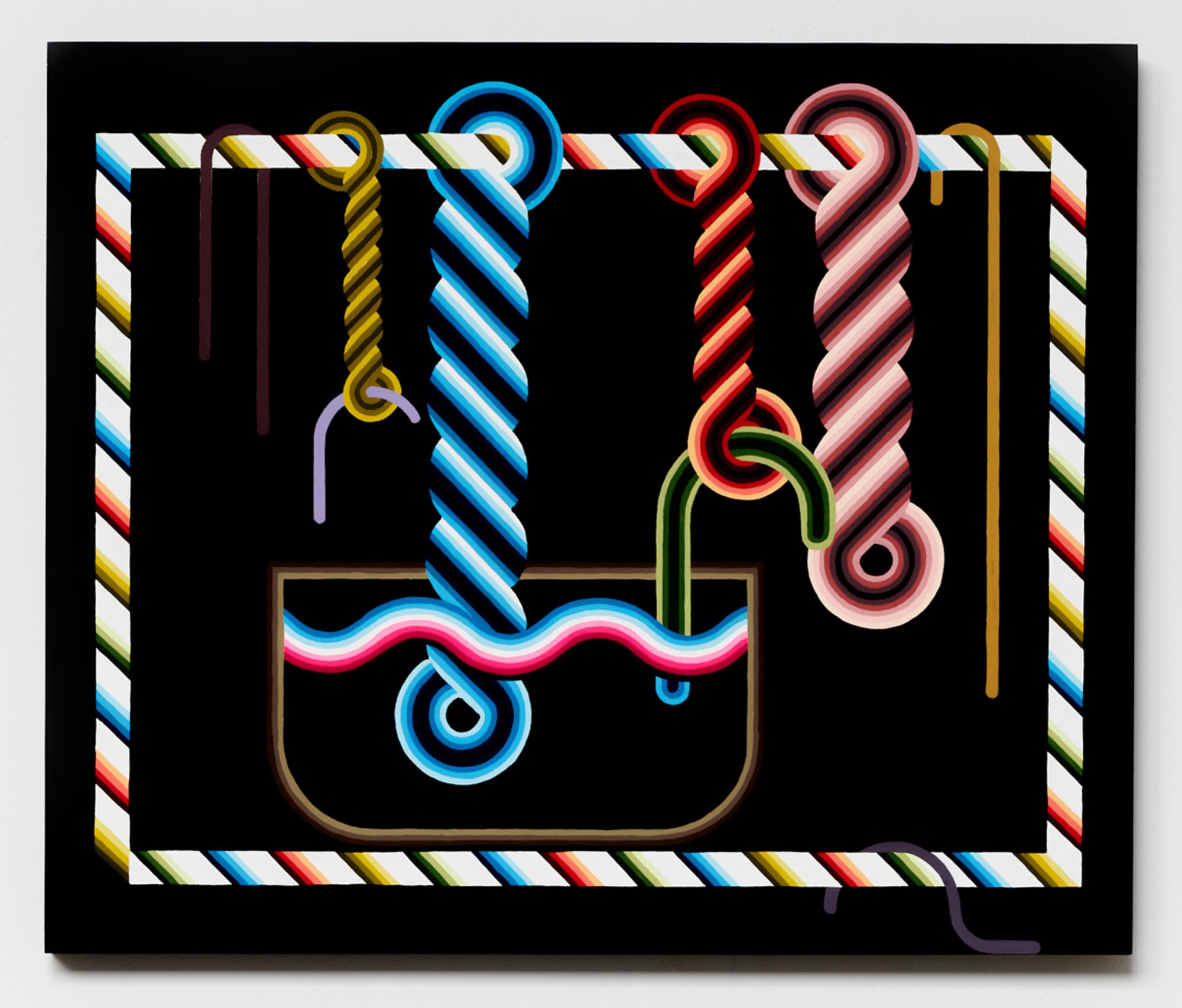
Plotted out beforehand using graphite pencil, rulers and protractors, and hand-painted with the illusion of hard-edged precision, Edie Fake’s artistic practice mines the grammar of architecture to carve out space for bodies that have been othered and invalidated by dominant systems of knowledge. Fake’s abstract representations of community form and collapse, cohere and dissipate, reflective of the real experience within queer lives and their ever-shifting constellations, while centering his central concern for the audacity of queer utopian imagining.
Since moving from first Chicago, then to Los Angeles while briefly attending grad school at USC, to the high desert of Joshua Tree in California, and currently Vancouver, BC, Fake’s work has evolved from his acclaimed Memory Palaces series — reimagined facades of urban lesbian bars and gay nightclubs — to a new feeling of vulnerability due to shifts in the U.S. social and political climate. The work blurs lines between architecture and body with structures adorned by elements that seem to be both decorative and protective. Architectural components are used as visual metaphors for the ways in which definition and validation elude trans identities. Says Fake, “More and more I’m trying to bring an anarchy into that architecture, or a fantasy and ecstasy of what queer space is and can be.”
Edie Fake’s (b. 1980, Evanston, IL) multi-media work — drawings, paintings, installations, comics, books and zines — has been exhibited in solo shows at the Museum of Contemporary Art, Chicago; Berkeley Art Museum and Film Archive; Everson Museum of Art, Syracuse; and in New York City at The Drawing Center, Broadway Gallery and Marlborough Gallery. His 2018 show at Western Exhibitions was reviewed in Art in America. Fake’s work is held in the collections of the Billy Ireland Cartoon Library & Museum, Columbus; Des Moines Art Center, Iowa; RISD Museum, Providence; KADIST, San Francisco; Nerman Museum of Contemporary Art, Kansas; and the Santa Barbara Museum of Art. He was one of the first recipients of Printed Matter’s Awards for Artists and his Gaylord Phoenix collection of comics won the 2011 Ignatz Award for Outstanding Graphic Novel. His work has been written about and featured in artforum, New York Times, The Paris Review, Art News, Art 21, Juxtapoz, Hyperallergic, The Comics Journal, and The Los Angeles Review of Books. Edie Fake was born in Chicagoland in 1980 and received a BFA from the Rhode Island School of Design in 2002. Fake is represented by Western Exhibitions in Chicago and Broadway Gallery in New York, and he currently lives and works in Vancouver, Canada